
Top Signs You Need Gate Repair Service – Don’t Ignore These
Most gate failures give you weeks of warning before they quit entirely. The trick is knowing which quirks are cosmetic and which are the early stages of a mechanical or electrical problem that gets more expensive every day you ignore it. Below we walk through the signs we look for, why noise is diagnostic data rather than background music, and how Evanston’s seasonal swings tend to hide developing problems until spring. If reading this makes you suspect your own gate, call (855) 658-5171 for a straight answer.
A gate that hesitates for two seconds before it moves isn’t “just slow.” It’s an operator fighting an alignment problem, a tired hinge, or a binding track, and that extra load is quietly shaving months off the motor’s life with every cycle. The gate still opens. The gate still closes. So the hesitation gets filed under normal, and the small fix that would have corrected it turns into a much bigger bill down the road.
Key Takeaways
- Operational quirks like a slightly slower start or a faint rattle are cosmetic; grinding, repeated reversals, and sagging are active stress signals.
- Every new sound your gate makes points to a specific part – learn to read it.
- Temperature swings hide developing problems through winter and reveal them in spring.
- Sagging gates, erratic reversals, and sensor failures are safety-critical and create real liability for property owners.
- A ten-minute monthly visual check catches most developing problems before they become emergencies.
What counts as a cosmetic quirk versus a real repair sign?
The line between “quirky” and “failing” comes down to whether the gate is working against something. A cosmetic quirk is a harmless quirk – a manual swing gate that needs a firm hand, a latch that catches if you push it just right, a powered gate that always stops at the same slightly-off position because someone set the limit there. None of those indicate stress. They’re personality, not pathology.
Active mechanical stress shows up differently. Watch for these:
- Slowing or hesitating before the gate starts moving, which means the operator is overcoming resistance.
- Uneven travel – the gate binds partway through the cycle and then frees itself.
- A motor that sounds labored or runs noticeably longer than it used to for the same open.
- Wheel or roller drag on a slide gate, where the carriage scrapes instead of glides.
- Hinges that pop or creak under load on a swing gate.
Each of those is the gate telling you a component is fighting the operator. Left alone, that load stresses the motor, the gearbox, and the control board – and what started as a $150 adjustment on a hinge or wheel can become a $900 operator replacement. In Evanston we see this exact progression often, especially on older powered gates where everything was fine last summer.
Why noise changes are diagnostic data, not background noise
Every gate system has a baseline sound, and once your ear learns it, any change is information. A grinding noise usually means metal-on-metal contact – a worn bearing, a dry roller, or debris in the track. A rhythmic clicking often points to a failing gear in the operator’s drive or a loose sprocket. A hum with no movement at all means the motor is getting power but something in the drive train or the control logic is stopping it. A buzz from the control box itself may be a transformer or a stuck relay.
This is where brand familiarity earns its keep. Operators from BFT and Viking, for instance, have distinct motor signatures and control behavior, and knowing what “normal” sounds like on a Linear or a Ghost Controls unit lets a technician localize a problem in minutes rather than guessing. In our experience, homeowners who describe a noise as “new” give us half the diagnosis before we even arrive. If a sound has changed on your gate in Evanston this month, that’s your cue.
Why Evanston gates seem to break in spring
The problems you notice in March and April usually started developing back in November. Cold contracts metal, stiffens grease, and makes tracks and hinges slightly tighter than they were in fall. The operator compensates by working a little harder, and because it still opens, nobody thinks twice. Add freeze-thaw cycles that shift soil and posts a fraction, and alignment drifts slowly out of tolerance through the winter.
Then the thaw comes, everything loosens, and suddenly the gate that “worked fine all winter” is grinding, binding, or reversing. The spring failure isn’t new – it’s the same problem that’s been building for five months, finally showing itself. This seasonal pattern is one of the reasons we recommend checking your gate in late fall before the cold sets in. A hinge adjustment or a track cleaning in November does more for longevity in Evanston than an emergency repair in April.
The safety-critical warning signs you can’t overlook
Some signs are about cost. Others are about liability, and those need action right away. Three belong in the “call today” category:
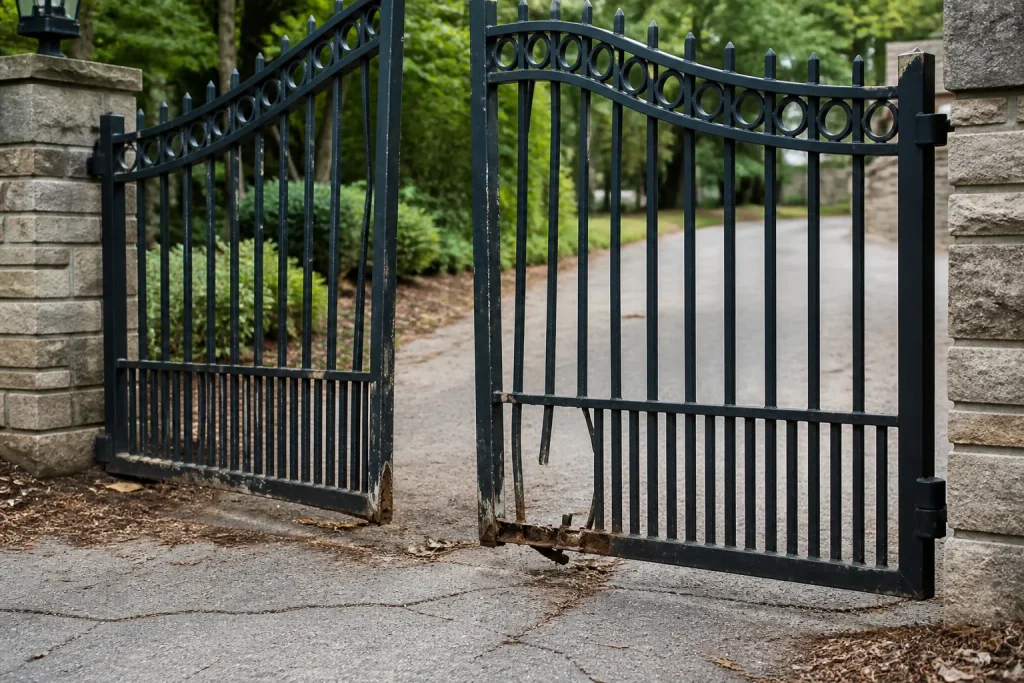
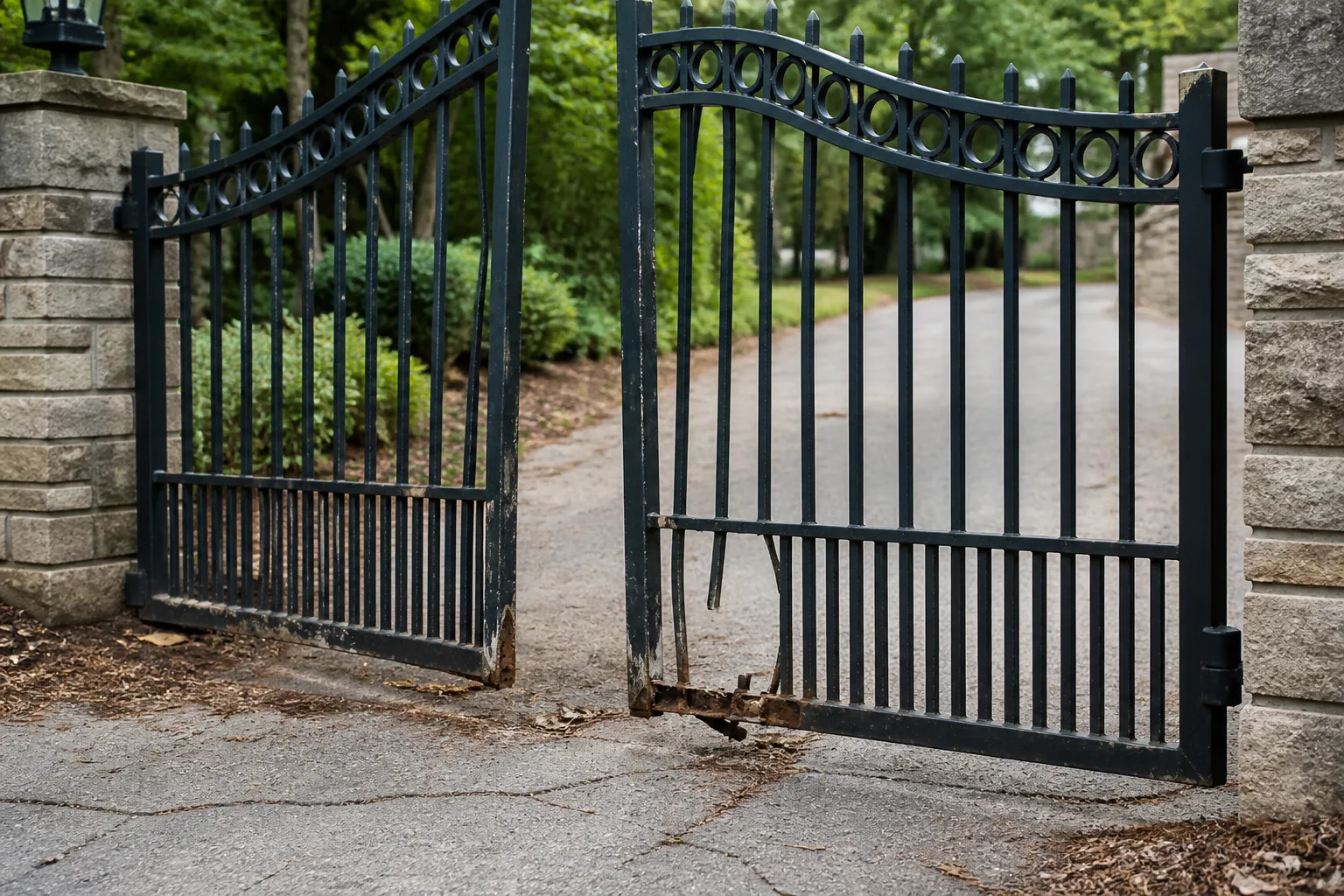
- A sagging gate. Drooping hinges or a bent frame mean the gate is no longer hanging true. A sagging panel can drag, stick, or – worse – fail under its own weight while someone is walking through.
- Erratic reversals. A gate that closes on someone and then reverses, or reverses when nothing’s in the way, has a failing safety device or a control board issue. That’s a crush hazard, not a nuisance.
- Dead or misaligned safety sensors. Photo eyes and safety edges exist to stop the gate. When they fail, the gate keeps moving with no idea anyone is there.
For a landlord or small commercial property manager, ignoring these carries real exposure – an automatic gate that no longer stops is a genuine hazard to anyone on the property. Electric gates are the primary security layer for many Evanston homes and businesses, and the safety circuit is what makes that automation safe to live with.
A ten-minute monthly check that catches most problems early
You don’t need tools or training to catch the majority of developing gate issues. Walk out once a month and look at these, in this order:
- Look at the gate’s line. Stand back and confirm the panel is level and hanging straight. A slight sag is your earliest hinge warning.
- Watch the full cycle. Open and close it once and listen for anything new – grinding, clicking, humming.
- Check the track or the swing path. Clear debris, leaves, and grit. A slide gate should glide without scraping.
- Test the safety sensors. Pass an object through the beam or press the safety edge – the gate should stop or reverse.
- Look at the hardware. Glance at hinges, rollers, and the operator housing for rust, looseness, or obvious wear.
That routine catches roughly 80% of developing problems before they become emergency calls. If any of it looks off, that’s the moment to bring in a specialist.
When to call a pro
If your gate is dragging, grinding, struggling to open, or has a safety device that isn’t responding, stop cycling it and get a technician out. Continued operation is what turns a small repair into a big one. We’re gate-only specialists, which means we diagnose gate repair problems faster because gates are all we work on – from the motor to the keypad. We work on the brand you already have, handle the mechanical, electrical, and digital parts in one visit, and quote the price before any work starts. Our technicians have up to 12 years of experience.
Related services in Evanston: if the issue is motor or opener related, see our gate motor & opener work, or for keypads, intercoms, and entry systems, our gate access control service.
The Bottom Line
Gates rarely fail without warning. They degrade in a sequence – a hesitation, then a new sound, then a binding cycle, then a dead operator – and the earlier you catch the pattern, the smaller the repair. Watch for hesitating movement, changed sounds, sagging, and safety devices that don’t respond. Do the ten-minute monthly check, and treat every “slightly off” symptom as information rather than background noise. If you’re in Evanston and need help, Gate Repair Evanston offers free estimates – call (855) 658-5171. We answer 24/7, with fast dispatch from 7am to 7pm, Sunday through Friday.
Frequently Asked Questions
Hesitation before movement is usually the first sign. When a gate pauses before it opens or closes, the operator is working against resistance – a binding track, a worn hinge, or an alignment issue – and that extra load wears the motor faster. Call (855) 658-5171 for a free estimate if you notice it.
A new grinding or clicking sound should be checked promptly. Those sounds usually point to metal-on-metal wear, a failing gear, or dry moving parts, and they get worse with every cycle. A technician can localize the problem quickly, often on a single visit.
Yes. A dead or misaligned safety sensor means your gate can move without detecting anything in its path, which is a real hazard. Stop using the automatic function and get it serviced before operating the gate again.
Winter is when the problem develops. Cold tightens metal, stiffens grease, and freeze-thaw cycles shift posts and alignment slightly. The gate keeps opening, so nothing seems wrong until the thaw loosens everything and the accumulated stress finally shows. A late-fall check catches it before it gets there.
Need a gate looked at in Evanston? Gate Repair Evanston handles swing and slide gates, operators, and access control – repair, replacement, and full installation – with free estimates and a written price before work begins. Call us and we’ll get you back up and running.
Written by the team at Gate Repair Evanston.
Need Gate Repair Help?
Call Gate Repair Evanston - the local pro we connect you with is licensed and insured, here with fast help in Evanston.
(855) 658-5171